Blog Posts

Adopting OODA Loop in Intrusion Detection & Response – it’s more than speed

Here is a great post by Richard able, on the concept of using OODA loop in Intrusion Detection and Response.

I have included some interesting lines here:

It is not absolute speed that counts; it is the relative tempo or a variety in rhythm that counts. Changing OODA speed becomes part of denying a pattern to be recognized…

The way to play the game of interaction and isolation is [for our side] to spontaneously generate new mental images that match up with an unfolding world of uncertainty and change…

Why we must encrypt

Bruce Schneier wrote an interesting post on his blog, about encryption, recently. This one is targeted towards the masses and so it touches upon the basics. He starts of by introducing the fundamental reasons for the use of encryption. But he also highlights some interesting facts about the concept of Encryption.

If we only use encryption when we’re working with important data, then encryption signals that data’s importance. If only dissidents use encryption in a country, that country’s authorities have an easy way of identifying them. But if everyone uses it all of the time, encryption ceases to be a signal. But if everyone uses it all of the time, encryption ceases to be a signal. No one can distinguish simple chatting from deeply private conversation. The government can’t tell the dissidents from the rest of the population. Every time you use encryption, you’re protecting someone who needs to use it to stay alive.

Encryption is the most powerful technology tool we have that can help us protect our privacy against cyber adversaries and also against the surveillance programs run by governments. And as Bruce also points out, the relevance of encryption has become the most, in today’s world, as countries like the US, UK, China and Russia are either talking about or implementing policies that limit strong encryption.

Here is a report which is the result of a collaboration between Privacy International, ARTICLE 19, and the International Human Rights Clinic (IHRC) at Harvard Law School. It explores the impact of measures to restrict online encryption and anonymity in four particular countries – the United Kingdom, Morocco, Pakistan and South Korea. It is a definite read.

Title Image courtesy: carra-lucia-ltd.co.uk

Harvesting Value from Open Data

On one side, we’re talking about Data Privacy, User Privacy, and legality of Survellience itself, but at the same time, there is Data that is supposed to be Public information and easily accessible by Human Beings, and also Computers, to process and take value out of it.

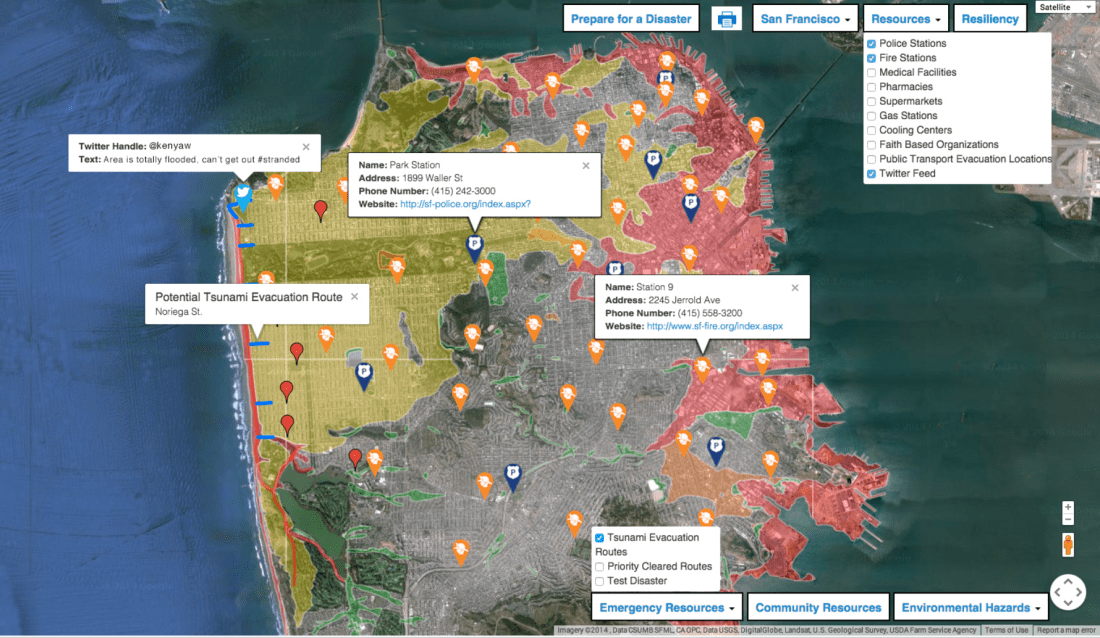
Just to set the context of this whole topic, here is a very interesting and extremely powerful use case that talks about a Dashboard created by the Open Data Analytics company Appallicious, which is being billed as a solution that pairs local disaster response resources with open data, and offers citizens real-time developments and status updates.

@jasonshueh has an interesting post on GovTech about the methods that could be used to harvest value out of Open Data repositories, for more such use cases.

Sunlight Foundation is a Washington, D.C. based non-profit advocacy group promoting open and transparent government. According to the foundation’s California Open Data Handbook, data must first be both “technically open” and “legally open.”

  • Technically open: [data] available in a machine-readable standard format, which means it can be retrieved and meaningfully processed by a computer application.
  • Legally open: [data] explicitly licensed in a way that permits commercial and non-commercial use and re-use without restrictions.

I think Junar is doing some interesting work in this area. And I especially liked these lines by Diego May, co-founder and CEO of Junar, in the article

What we see today is that the real innovation is not necessarily coming from hackathons, but now it’s about working with companies or entrepreneurs to solve problems

University of Massachusetts Boston is also doing some interesting work in this area and also the Fraunhofer Society in Berlin are doing some great research in this space.

This (Open Data Analytics) and the relevance of Security in it, is going to be one of the interesting areas in the Data Analytics space.

NetFlow-based security tool for Incident Response

Charles Herring of Lancope has a short but interesting post on how NetFlow data can be leveraged for Incident Response purposes.

He says

The collection and analysis of network metadata, such as NetFlow, is an effective way to identify advanced attacks, insider threats or data exfiltration.

There are three major features/activities required by an effective NetFlow management tool:

  • Deduplicate the flow to remove redundant information
  • Directionality to determine the relationship between flow endpoints
  • Robust Querying capabilities

There is a Part 2 coming up soon, which will focus on the Analytics aspects of this.

Title Image courtesy: jimjansen.blogspot.com

Identifying actionable threat intelligence

Ran Mosessco from Websense Security Labs has a very interesting post on solving a key issue every Security Analysts in a SOC (Security Operations Center) faces – the overwhelming amount of security alerts (even after correlation), also called Attack Indicators, an Analyst has to acknowledge and investigate.

Actionable threat intelligence is buried deep within terabytes of seemingly interesting but irrelevant data. Plausible deniability, false positives, lack of traceability and attribution, skillful attackers, adaptation of warfare techniques, and the like only add to the confusion. How does one bubble up prioritized, actionable threat intelligence in an automated fashion from the depths of the data morass?

This approach is still at a nascent stage and requires further study and we need to come up with an implementable solution. But I think this is a good place to start, and the following lines capture the way forward, accurately:

With attacks becoming more advanced and sophisticated each day, combining big data engineering, unsupervised machine learning, global threat intelligence and cybersecurity know-how is required to deal with them in a timely, automated and efficient manner.


This topic is one of my key focus areas professionally, and so I will be writing more about it here. 

Title Image credit: communities.websense.com

Analysis of China-based APT “Deputy Dog” by FireEye and Microsoft TI teams

FireEye has just released an interesting report on the obfuscation techniques used by China-based APT “Deputy Dog”. The FireEye TI (Threat Intelligence) team reportedly found suspicious activity on Microsoft’s TechNet site, early last year, which appeared to have been related to the BLACKCOFEE malware, a malware supposedly employed by the same group in China.

In late 2014, FireEye Threat Intelligence and the Microsoft Threat Intelligence Center discovered a new Command-and-Control (CnC) obfuscation tactic on Microsoft’s TechNet web portal—a valuable web resource for IT professionals.

The threat group took advantage of the ability to create profiles and post in forums to post encoded C2 for use with a variant of the malware BLACKCOFFEE. This technique can make it difficult for network security professionals to determine the true location of the CnC, and allow the CnC infrastructure to remain active for a longer period of time. TechNet’s security was in no way compromised by this tactic.

Here is a representation of the technique by the FireEye team:

Screen Shot 2015-05-14 at 9.00.09 pm

This is a really smart way of fetching and using the C&C IP address, by the attacker, and detecting this communication is going to be a bit tricky and interesting, and so the adversaries will use these obfuscation techniques more often.

The FireEye team has also shared the Indicators of compromise for this, on Github, which will come in very handy to tune our detection rules.

iPhone to become a key tool in genetic studies 

@AntonioRegalado of MIT Tech Review reports this. 

This is an interesting move by Apple, and I see ResearchKit playing a key role in the healthcare industry’s adoption of Technology to spearhead research initiatives.  

Apple is collaborating with U.S. researchers to launch apps that would offer some iPhone owners the chance to get their DNA tested, many of them for the first time, according to people familiar with the plans.

The apps are based on ResearchKit, a software platform Apple introduced in March that helps hospitals or scientists run medical studies on iPhones by collecting data from the devices’ sensors or through surveys.